Electronic shelf labels, AI-enabled cameras, IoT sensors and connected systems are giving retailers more timely visibility into what is happening in physical stores. By bringing these signals together, retailers can build a continuously updated operational view of the store rather than relying only on separate systems or periodic observations.
The opportunity now extends beyond deploying connected technology. Retailers also need the operating model, governance and workflows required to turn store visibility into a practical management capability, both at individual store level and across the wider network.
This is the ambition behind Hanshow's Store Digital Twin approach: connecting store infrastructure, operational intelligence and execution so that teams can move from visibility to action.
The physical store as a source of operational signals
Physical stores have traditionally had less continuous visibility than digital channels. Shelf conditions often depend on periodic checks, and operational exceptions may only become visible after they have already affected product availability, execution or the customer experience.
With the deployment of electronic shelf labels (ESLs), AI-enabled sensing and connected devices, the store can provide more timely information on authorised price updates, on-shelf availability, product location and merchandising execution. These operational signals are paving the way for a new approach to store management: the Store Digital Twin.
What is the Store Digital Twin?
Already widely adopted in sectors such as manufacturing, aerospace and energy to manage complex infrastructure, the digital twin concept is now emerging as a new transformation lever for retailers.
Applied to retail, a Store Digital Twin is a continuously updated operational view of the physical store combining Iot’s and Retailer’s data. It connects shelf conditions, products, shopper journeys and store operations, helping teams understand what is happening, decide what requires attention, coordinate the appropriate response and verify the outcome. As the capability matures, it can also support more predictive and optimisation-oriented use cases.
Hanshow's NexFamily portfolio provides interconnected touchpoints across the store, while xPilot helps translate operational insights into prioritised actions, task orchestration and outcome verification.
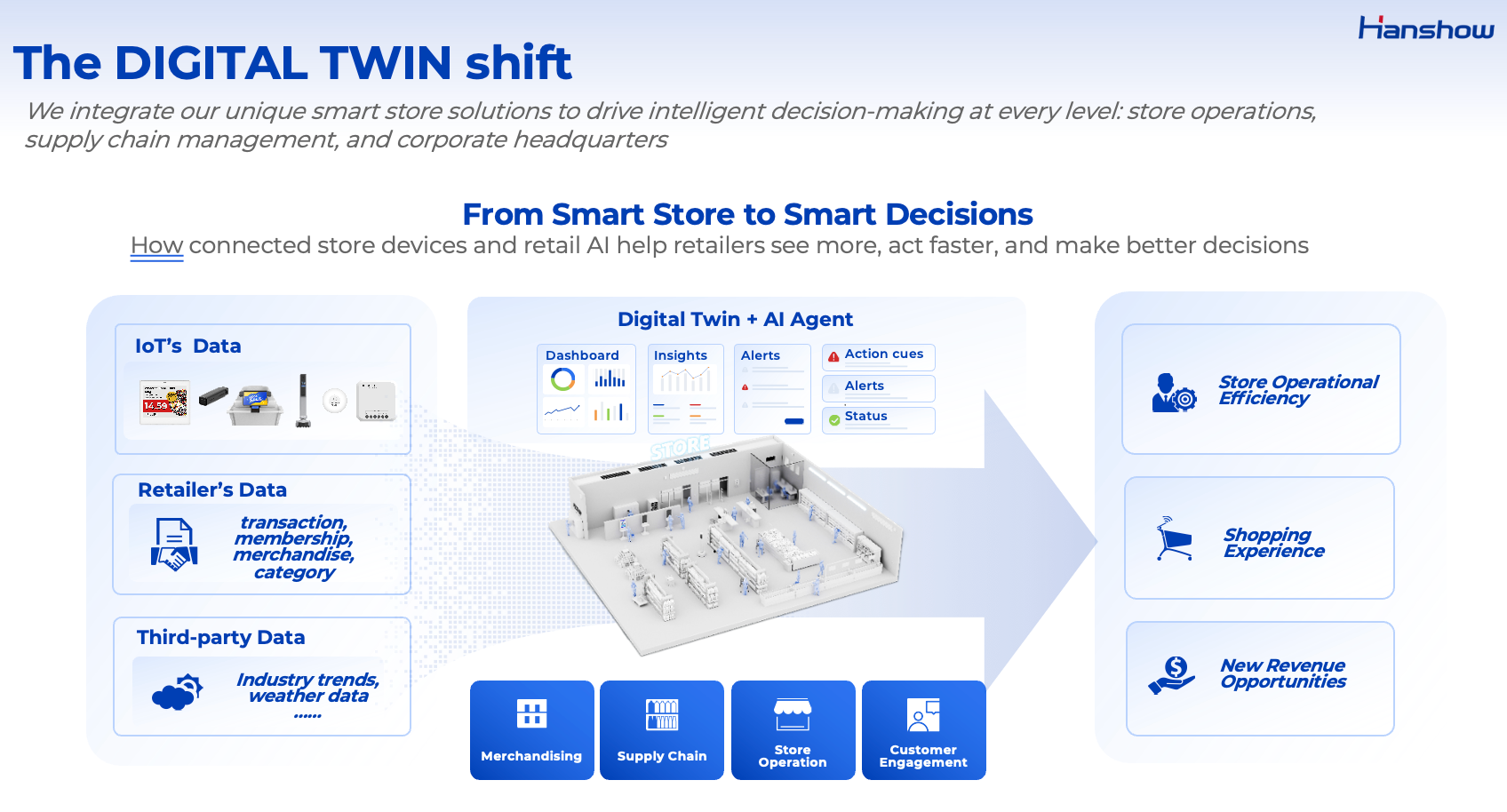
● NexShelf: an intelligent shelf foundation combining Nebular Ultra Electronic Shelf Labels, precise item-level location intelligence and N5 AI-enabled shelf sensing to make shelf conditions visible, measurable and actionable.
● NexConnect: a connected Smart Cart solution that supports guided item finding, basket management, self-checkout and contextual retail media activation, subject to the retailer's permissions and governance framework.
● NexMate: inspection and cleaning robotics that support store visibility and routine execution across store aisles.
● NexOptim: IoT capabilities that support the intelligent management of technical equipment, including temperature and energy-related operations.
● NexGrid: energy generation, storage and management capabilities that can connect photovoltaic installations with wider store energy needs.
By connecting these capabilities progressively, retailers can develop a more unified operational view of the factors influencing store performance, while extending the architecture according to their priorities and level of digital maturity.
Cross-analysing indicators such as on-shelf availability, planogram compliance, product turnover and shelf productivity can support more informed merchandising decisions and better-targeted actions.
Consider an illustrative workflow in a high-turnover category such as dairy. AI-enabled shelf sensing identifies an empty space, while item-level location intelligence determines which product should be present. The system can then generate a replenishment recommendation and route a task to the appropriate store team, while the relevant shelf location can be highlighted through the ESL infrastructure.
The Store Digital Twin can then combine the shelf condition with relevant sales and operational context to help distinguish a one-off exception from a recurring replenishment issue. Once the shelf has been replenished, the outcome can be verified and fed back into the system, strengthening the next recommendation.
Across a store, and then across an entire network, this closed-loop approach helps teams identify exceptions earlier, prioritise work more effectively and improve on-shelf availability without depending only on periodic checks.
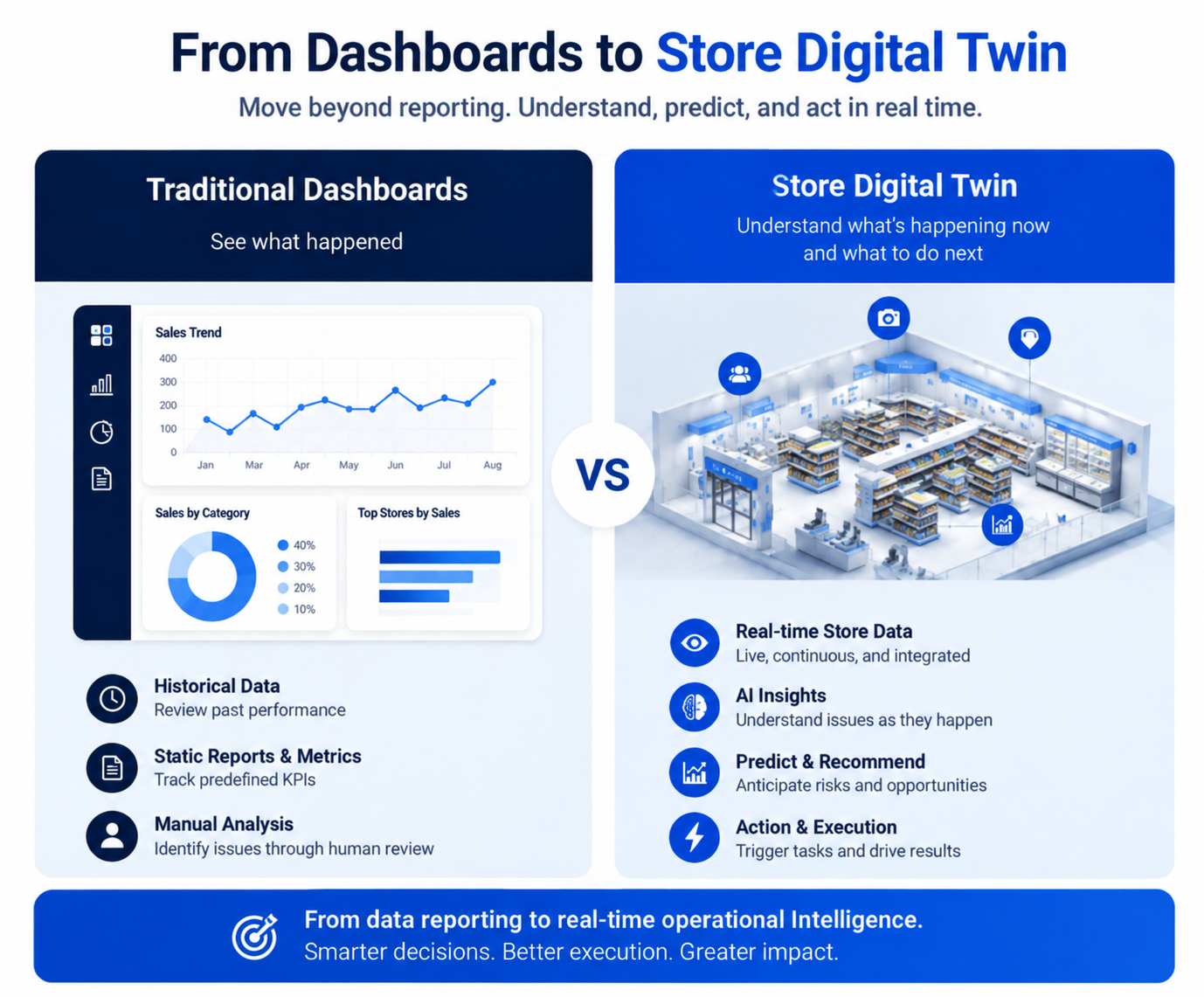
The next generation of physical retail will not be defined by simply adding AI features, but by retailers' ability to use timely operational signals to detect exceptions, coordinate decisions, trigger the right actions and verify outcomes.
Together, these capabilities bring the Store Digital Twin and NexFamily architecture to life. They help retailers move beyond operational visibility towards a continuously improving management model in which each decision, action and outcome can inform the next one. More advanced predictive capabilities can then be introduced progressively as the underlying information, workflows and adoption mature.
.jpg)
The organizational conditions for successful transformation
While the technological infrastructure is becoming increasingly mature, the ability of organisations to turn operational visibility into consistent decisions and actions is what makes the difference today.
In other words, the value of the Store Digital Twin lies not only in representing the store, but in changing how teams prioritise work, coordinate decisions, execute tasks and learn from the results.
Creating a true Store Digital Twin therefore requires changes in operating models, governance, decision rights and day-to-day workflows:
● Establish clear governance, with defined responsibilities, shared KPIs, appropriate access controls and a common understanding between headquarters and store teams of how operational information will be used.
● Move from a reporting mindset to an action-and-verification mindset. Operational signals should not only explain what has happened, but trigger the appropriate response: addressing an on-shelf availability issue, correcting a display, resolving a price discrepancy or managing an exception before it affects the customer experience. The outcome should then be measured and fed back into the system.
● Define clear decision rights by identifying which actions store teams can take directly, which require approval and how exceptions should be escalated.
● Build a shared operating culture by involving store associates early and training both store teams and central functions to interpret recommendations and incorporate them into practical, intuitive day-to-day workflows.
● Develop use cases progressively, starting with measurable priorities such as improving on-shelf availability, ensuring price accuracy and strengthening planogram compliance. Once these workflows and feedback loops are established, the Store Digital Twin can expand towards more advanced optimisation, simulation and predictive use cases.
The adoption of Store Digital Twins marks a strategic shift for retail. The physical store is becoming a source of continuous operational insight and a management environment in its own right. The Store Digital Twin becomes valuable when visibility leads to prioritised action, action is verified and every outcome improves the next decision. Technology provides the foundation, but operating models, governance and store-team adoption determine whether that foundation creates measurable value at scale.
Join us at Tech For Retail on November 30 and December 1, 2026, at Paris Expo Porte de Versailles, Hall 7.2, Booth B31, to discuss the practical implementation of the Store Digital Twin and discover the NexFamily offering.